DTN 155: Physical AI Becomes Manufacturing's Next Advantage
Plus: Uber taps Rivian for robotaxis, SpaceX hits 10,000 Starlinks in orbit, China approves first brain implant, Nvidia unveils hardware for orbital data centers, drone warfare sharpens focus on laser defense, and more.

We're hosting our first Space + Defense Happy Hour in DC.
Join space and defense founders, investors, and media on March 24 for an evening of networking and drinks, just down the road from Satellite 2026 and The Hill & Valley Forum.
Deep Tech Newsletter subscribers are guaranteed entry until we reach capacity. RSVP below to reserve your spot!
RSVP TO SPACE + DEFENSE HAPPY HOUR


"At the earliest days of a deep tech company, you are trying to paint a future that no one knows exists. You have your unique vision of a future and you have to convince everybody around you to come along with you, even though all the odds are stacked against you."

Why physical AI is becoming manufacturing’s next advantage
“AI is no longer confined to planning or analytics. It is moving into physical execution. This transition exposes a critical gap. Traditional automation excels at repetition but struggles with adaptability. Physical AI closes that gap by enabling human‑led, AI‑operated systems, where people set intent and intelligent systems execute, learn, and improve over time.”

- Portal, Paladin team on debris removal service
- Uber taps Rivian to build robotaxis in deal worth up to $1.25B
- Geothermal startup Fervo catapults itself over the ‘valley of death’
- Quantum cryptography pioneers win turing award
- Nvidia says restarting production of China-bound chips
- China is a serious contender in the race for fusion energy
- The next phase of artificial intelligence may require very different processors
- Xaira unveils AI model X-Cell for predicting virtual cells
- AI startup Basecamp Research announces trillion-gene project
- TransAstra aims to move 100-ton asteroid to stable orbit for processing
- Rocket Lab wins $190 million Pentagon deal for hypersonic test flights
- Why the militaries are scrambling to create their own Starlink
- The Pentagon is developing alternatives to Anthropic, report says
- Rise of drone warfare sharpens focus on laser defense
- China just approved its first brain implant for commercial use, a world first
- The Pentagon is backing nuclear waste recycling for long-lasting military power sources
- SpaceX reaches milestone of 10,000 Starlink satellites in orbit
- China is developing low-cost lunar cargo options for its expanding moon program
- Starcloud files plans for 88,000-satellite constellation
- Nvidia unveils new hardware to unlock orbital data centers
- How the Pentagon is working to wriggle out of China’s rare-earths grip
- Army awards Anduril counter-drone task order as first in new $20B ‘contract vehicle’

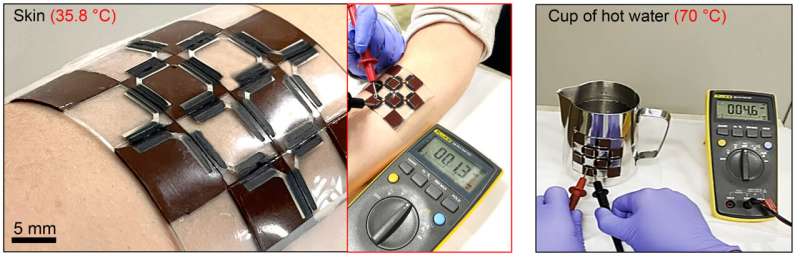
“Thermoelectric generators, which convert temperature differences into electricity, are attracting attention as a next-generation energy technology for wearable electronics because they can supply power without batteries. In particular, thin-film thermoelectric generators are lightweight and flexible, allowing them to be comfortably attached to skin or clothing.” (via Tech Xplore)

- High-performance LFP cathodes have potential to extend electric vehicle range
- Swimming robot propelled by lab-grown muscle hits record speed
- Lead-free thin films turn everyday vibrations into electricity
- Light-activated material offers new approach to carbon dioxide conversion
- Acoustic metamaterial can send complex signals directly between water and air
- Sheepdogs reveal a better way to guide robot swarms
- Swapping batteries for hydrogen gives drones a whole new range
- Benchtop bioreactor simplifies macrophage manufacturing
- Sulfide coating boosts lithium-ion battery lifespan past 1,000 cycles
- No battery needed: Single organic device can act as both indoor solar cell and photodetector
- Novel AI semiconductor uses hydrogen ions for learning and memory
- 4D printing technology uses waste sulfur to enable self-actuating soft robots
- Dual electrode system cracks seawater electrolysis deposit problem
- Autonomous navigation of microrobots in complex flows demonstrated for the first time
- Compostable robot endures over 1 million uses before becoming plant food
- Ultrasound-activated nanoparticles breach bacterial biofilms

- Verily raises $300M to advance AI-native precision health platform for research and clinical workflows
- Congruence Therapeutics raises $39.5M to advance small molecule correctors for genetic obesity and Parkinson's disease
- Unnatural Products raises $45M to develop macrocyclic peptide therapies for cardiometabolic and inflammatory diseases
- ISPTech raises €5.5M to scale green propulsion tech
- iMetalX emerges from stealth with technology to model resident space objects
- Dimension raises $700M for third fund backing AI and science companies
- Rubi raises $7.5M to scale carbon-to-materials production system
- Surf Therapeutics raises undisclosed seed extension to advance non-invasive ultrasound neuromodulation for immune pathways
- R1 Therapeutics raises $77.5M to advance AP306 phosphate inhibitor for chronic kidney disease
- iDEL Therapeutics raises €9M to develop cytosolic drug delivery platform for cancer therapeutics
- GA Drilling raises $44.1M to commercialize NexTitan system for deep geothermal drilling
- Mestag Therapeutics raises $40M to advance fibroblast-targeted therapies for cancer and inflammatory diseases
- GridBeyond raises €12M to scale AI-powered platform orchestrating distributed energy assets across global markets
- AgZen raises $10M to scale droplet-level precision spraying technology for agriculture
- Fibionic raises €3M to industrialize fiber placement technology for ultra-light composite manufacturing
- Halcyon raises $21M to scale AI platform for energy market intelligence and regulatory data
- Great Sky raises $14M to develop superconducting optoelectronic networks for neuromorphic computing
- Advanced Navigation raises $110M to scale GPS-independent autonomous navigation systems
- Crossbow Therapeutics raises $77M to advance TCR-mimetic T cell engagers for blood cancers
- Edra raises $30M Series A to automate workflows by building knowledge bases from operational data
- Excalipoint Therapeutics raises $68.7M to develop tri-specific T cell engager antibodies for cancer and autoimmune diseases
- Xbow raises $120M to scale autonomous offensive security platform testing applications for vulnerabilities
- Cocoon Carbon raises $15M to commercialize LoopCem cement substitute from steel slag
- Arc Boat Company raises $50M to expand electric propulsion systems into commercial and defense markets
- Autoscience raises $14M to build AI systems automating machine learning research and deployment

Iran war energy shock sparks global push to reduce fossil fuel dependence / The strait of Hormuz blockade will strangle US defense industry / North Korea's 100k fake IT workers net $500M a year for Kim / ArXiv, the pioneering preprint server, declares independence from Cornell / Meta is shutting down Horizon Worlds on Meta Quest / What do new nuclear reactors mean for waste? / FDA seeks to encourage fewer animal studies with new draft guidance / Starlink militarization and its impact on global strategic stability / Human organ atlas / 'Pokémon Go' players unknowingly trained delivery robots with 30B images / Ryugu asteroid samples contain all DNA and RNA building blocks / Why do humanoid robots still struggle with the small stuff? / Who covers AI business blunders? Some insurers cautiously step up / A 100-year-old theory might explain what’s wrong with quantum mechanics / How Invisalign became the world’s biggest user of 3D printers / An asteroid just exploded above Ohio with the force of 250 tons of TNT / On the flightline with Swedish fighter jets on a NATO mission