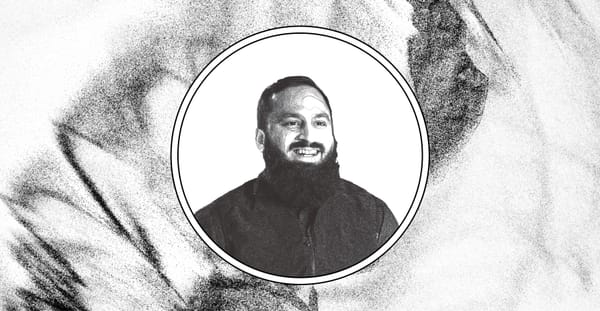
Fighting Fire with Sound Waves with Sonic FireTech’s Geoff Bruder
Geoff Bruder is the co-founder and CEO of Sonic FireTech, a company developing acoustic fire suppression systems that use sound waves to extinguish flames.
Geoff Bruder is the co-founder and CEO of Sonic FireTech, a company developing acoustic fire suppression systems that use sound waves to extinguish flames.

What is Sonic FireTech?
We’re suppressing fire with sound waves. What I like to tell people is we’re changing the paradigm on how fire is approached to be proactive rather than reactive. Every existing fire suppression technique basically waits until they’re very sure there’s a fire before triggering. That’s because these systems destroy everything. They’re either drenching everything with water, spraying chemicals, or if you’re looking at something like a data center, they’ve gone back to using displaced oxygen. So they’re pumping in nitrogen and making it so the oxygen levels are too low for fire to exist. But people can’t exist either, so they’re extremely dangerous. Because there’s no side effect to our system, we can use the most sensitive detectors around and trigger within milliseconds of a spark to make sure that a fire can’t grow.
What led you to found Sonic FireTech?
My co-founder Michael Thomas had been working on something adjacent to this. He’s a lawyer with no engineering degree, but very ambitious and stubborn. He was looking at a drone that could dive into wildfires and fight them from inside. He was using parallel pressure waves. He got to a point where he needed some technical help and started doing some Googling. He found patents that I had published while at NASA and reached out to me on LinkedIn. He said, “Hey, I’m thinking about doing this. What do you think?” We ended up linking up and starting the company shortly thereafter. I ended up in the CEO role just by happenstance. I’m much more comfortable in the lab building stuff.
How did your NASA background prepare you for this technology?
My background at NASA was working on power systems for planetary missions. Have you ever seen the movie “The Martian”? If you recall, Matt Damon pulls this white box out of the ground at one point and it keeps him warm in the rover. He pulls it out because it’s got plutonium in it. That box is called the MMRTG, the Multi-Mission Radioisotope Thermoelectric Generator. I was working on the replacement for that, which used Stirling engines to make a more efficient version.
Then I ended up working on a Venus mission where that box wouldn’t survive. We needed something simpler. I came up with a new architecture that converted heat energy into high-intensity acoustic waves. Those waves could then be converted into usable power and cooling for a lander. We were trying to survive one Venus day, which is 243 Earth days. The Soviet Venera lander’s titanium ball melted in just 127 minutes on that surface.
I patented that and licensed it to a group out of Silicon Valley. I left NASA to help them commercialize it. In the process of making power systems that used acoustic waves internally, I was building high-intensity, high-efficiency acoustic systems for the past 15 years or so.
Others have tried acoustic fire suppression before. What’s different about your approach?
DARPA and two students from George Mason University who formed a company called Force SV are the notable folks who tried this before. They were both using subwoofers. Subwoofers are much less than 1% efficient. If you hear a car going down the street with the trunk rattling, they’re throwing thousands of electrical watts to get maybe a single acoustic watt out of that.
In the engines I was working on at NASA, we needed to create and receive acoustic waves. That was the biggest loss in the system, so we needed to operate at 80% to 90% efficiency. The first pass I took at this, I bought parts from Home Depot and AutoZone along with a high-end subwoofer. I did a lot of the tricks I knew to force efficiency and was able to put a fire out from seven feet away. The furthest we had seen anybody do it before was about 18 inches. We melted the speaker in a couple of minutes, but showed that it was possible.
How does acoustic fire suppression actually work?
For fire to exist, you need three things: heat, fuel and oxygen. We’re essentially vibrating the oxygen faster than the fuel can use it, so it breaks the chemical reaction. At a high level, that’s what’s happening. You can get down into boundary layer theory and lots of other very technical stuff, but that’s the core of it.
The system is really good at containment. If we come up to a campfire that is going to spread to the forest around it, we can contain that and it’ll just burn itself out. The worst-case scenario for us is a fire that has been burning for a long time. We need to run until that wood cools below its self-ignition temperature or else it’s going to reignite.
Who are your customers today?
Everything we’re focused on immediately is nonregulated spaces so we can get up and running. We’ve got the ambitious goal of being able to help eradicate or contain wildfires. But we need to be a business that can actually keep the doors open to develop the tech to get there.
We’re selling to homeowners mostly in California between Santa Barbara and Los Angeles. We’re also selling to utilities. We’ve got a demonstration contract with PG&E and now we’re working with a subcontractor for SoCal Edison as well.
We’ve focused on a single product: a 500-watt box that can accomplish all of the things we’re after. We’re working on a 5-kilowatt version as the second generation. That same box can be used in all different use cases.
How does the home protection system work?
The way homes catch fire in a wildfire is embers assault the side of the building and accumulate in small piles. Then that pile lights a small fire that burns your structure down. If you can either knock thermal energy out of the embers or get them away from the house, you can stop that from happening.
We ran a test last week with a thermal camera. The system runs below audible, so you can’t hear anything. But there’s basically a force field around the building. The embers get deflected away. What gets through ends up burning through its energy quickly because it gets agitated by the vibrating air.
We actually put a system on somebody’s home in Santa Barbara and lit fires probably 20 times over a couple of days. We’re using about as much power as a light bulb to do this. What we’re trying to do is operate towards resonance, the lowest energy state. We force the system to achieve mechanical, electrical and acoustic resonance all at the same time.
What’s the long-term vision for Sonic FireTech?
The home use case makes a ton of sense for us, both internal and external. There’s not enough water infrastructure through the country to support everyone having interior home protection. And water sprinklers don’t do anything for grease fires, which are your No. 1 problem.
The larger 5-kilowatt system could go in storage warehouses, chemical storage facilities and any industrial application. Data centers are becoming more common with AI and crypto. They’re trying to pack more power into each one, so the fire hazard increases exponentially.
The most fun thing we’ve chatted about is using this for space habitats. There is no good way to put out fire in space right now. As we’re looking to make lunar colonies and Mars colonies, you need a good solution. You can’t have a sprinkler system in a lunar habitat because water would just turn into a big glob. It would be great for us to come back to our NASA roots and provide that capability.
How do you define deep tech?
Deep tech is essentially doing something funky with physics that people haven’t seen before. If it takes some explaining and some convincing, then it’s probably deep tech.

Infinite Frontiers is made possible by HAUS, the leading public relations agency for deep tech startups and scaleups.