DTN 187:Tissue Engineering Takes Shape
Plus: US voters reject data centers in ballot measures, Google first space data center satellite is writing poetry, Exin Therapeutics' AI agent performs brain surgery on a mouse, the dream of cold fusion is dying, UK Green Party drops longstanding opposition to nuclear power, and more.
“We want to be the industrial company for anything off Earth. When you think of a company like Bayer or DuPont, those are the kinds of companies we want to eventually be compared with.”

Tissue Engineering Takes Shape
“More than 18,000 people sustain traumatic spinal cord injuries in the U.S. annually, with approximately 310,000 patients living with the condition. The injured spinal cord has little regenerative capacity and develops a cellular and extracellular environment that inhibits neural regrowth.
Tissue engineering is on the move from an ambitious idea toward everyday clinical reality. At the interface of biology, materials science, and engineering, the field seeks to repair or replace damaged human tissues and organs. Some approaches embrace personalized medicine, creating tissues and treatments from a patient’s own cells and materials. Others are developing off-the-shelf engineered products for broad availability.
Matricelf, for example, is developing NewRal, a 3D neural-tissue transplant composed of patient blood-derived iPSCs as well as an extracellular-matrix hydrogel derived from the patient’s omental tissue. Before transplantation, the cells differentiate and assemble into 3D neural tissue spheroid constructs containing electrically active neural cells, designed to replace damaged neural tissue and support new neural connections.” (via Genetic Engineering & Biotechnology News)

- US voters roundly reject data centers in ballot measures
- Google's first data center satellite is online and writing poetry
- Texas was the new epicenter of the AI data center buildout. That might be kaput.

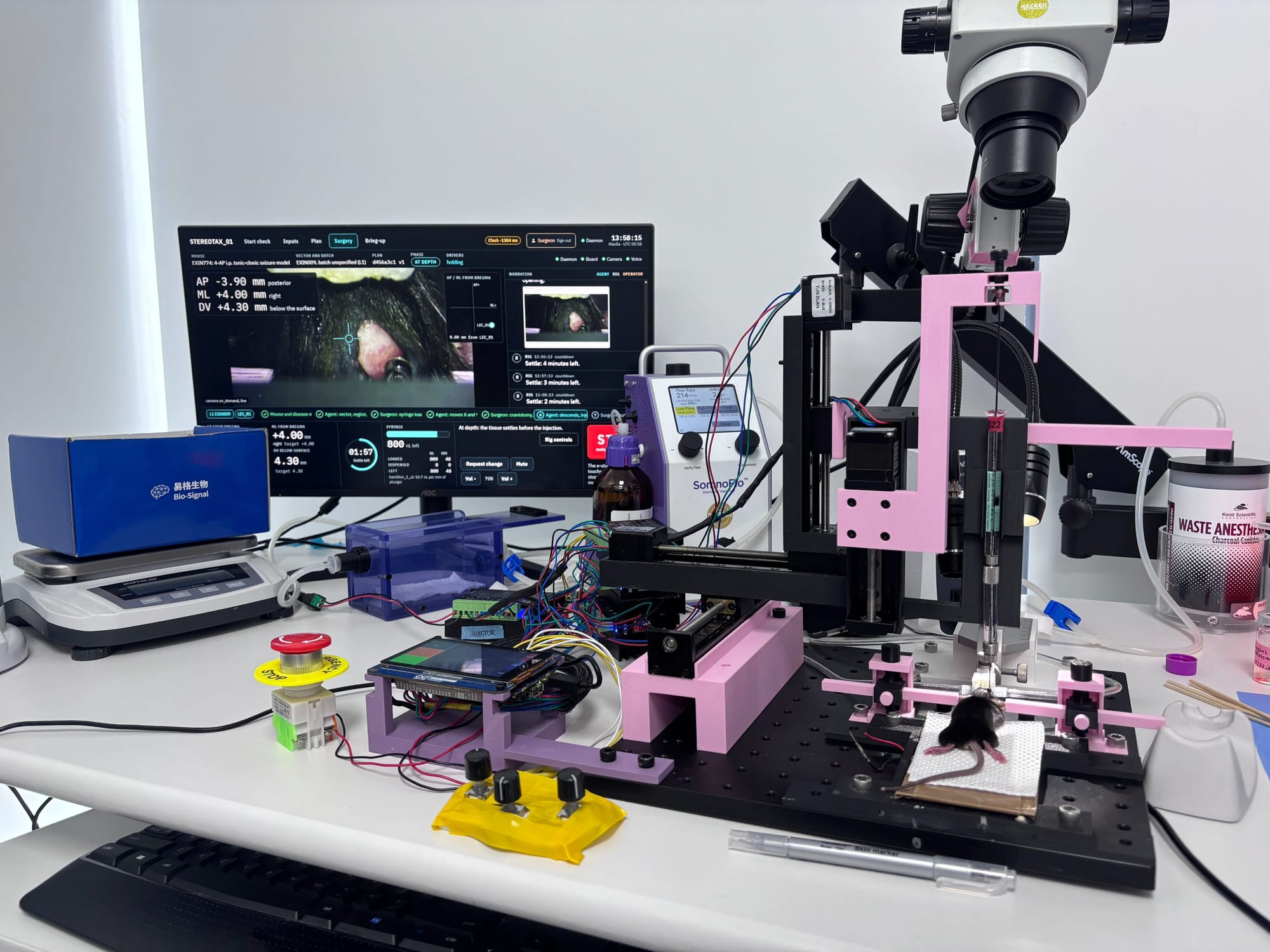
On October 27 an AI agent performed brain surgery on a mouse.
Exin Therapeutics CEO and Co-Founder Gabriel Ocana-Santero and his team gave it 19 gene therapy vectors in a spreadsheet, a mouse model of epilepsy, access to a motorize surgery rig with cameras and one goal: reduce seizures.
It picked the drug. It picked the brain region. It derived the coordinates from three papers. Then it drove the stereotaxic arms into the brain and injected 250 nanolitres while watching the entry site through the rig camera for bleeding. (via X / Gabriel Ocana-Santero)

- AI helps find better recipes for 3D-printing titanium parts
- Graphene networks help lithium-ion batteries store more energy and deliver more power
- China space experiment creates coldest temperature ever
- Ultrathin solid-state battery uses tin and carbon to reduce lithium loss
- AI company's research deepens mystery of vaults, cells' strangest particles
- Threaded ultrasound lens reveals chip defects previously hidden by internal noise
- Isolator-free optical transmitter could simplify high-speed links between data centers
- Let there be light—novel AI framework runs on optical hardware

- Zipline raises $1.5B for an autonomous drone delivery network for healthcare, retail, and food
- CesiumAstro raises $730M for a 737-satellite broadband and in-space compute constellation
- Northwood Space raises $375M Series C for a global modular satellite ground-station network
- Harbinger raises $240M Series D for electric trucks, emergency vehicles, and military driverless platforms
- Warp Sciences raises $215M for a US-based AI and robotics drug compound synthesis CRO
- Laza Medical raises $160M Series B for AI-powered robotic imaging for cardiac interventions
- T-Therapeutics raises $133M for T-cell receptor therapies for cancer and autoimmune disease
- Dulo raises $130M seed for an AI foundation model for software engineering and technical automation
- Hypersonica raises €100M Series B for sovereign hypersonic deep-strike systems for Europe
- Setara Biosciences raises $90M Series A for genetics-driven TRPV4 inhibitor targeting rare neuromuscular disease
- Alethio Therapeutics raises $90M Series A for first-in-class G6B antibody targeting rare blood cancers
- Tutor Intelligence raises $75M Series B for internet-connected robot workers trained by remote human tutors
- &Truth raises $70M seed for mathematically proving code is safe, secure, and correct
- 42AI raises $62.5M seed for a behavioral world model that predicts individual human decisions
- Humble Robotics raises $51M Series A for fully autonomous electric Class 8 freight vehicles
- Trajectory raises $45M Series A for continual post-training of AI models by domain experts
- Anaheim Bio raises €40M Series A for a small molecule inhibitor targeting calcium pyrophosphate deposition disease
- Opentrons raises $40M Series E for lab robotics, software, and data infrastructure
- Corridian raises $38M seed for ultra-large autonomous underwater vehicles moving payloads at ocean scale
- Specific Biologics raises $35M Series A for gene-editing therapies removing disease-causing DNA repeat expansions
- Vaeridion raises €30M Series A2 for nine-passenger all-electric regional aircraft
- FluoRok raises $30M Series A for fluorochemicals manufacturing without hazardous hydrogen fluoride
- bit.bio raises $25M Series D for scalable human cell type production via opti-ox platform
- Biograil raises €20M for an oral capsule device delivering biologics into the stomach mucosal wall
- Newleos Therapeutics raises $15.5M grant for oral small molecules treating neuropsychiatric and substance use disorders
- Cent raises $15M Series A for AI-powered full-body preventative screening and early disease detection
- Atlas Bio raises $11M seed for an AI foundation model simulating Phase II clinical trials in silico
- Syncere raises $11M pre-seed for a robotic floor lamp that does household chores
- Physicl raises $10M seed for high-fidelity 3D synthetic data to train robots
- Quint Computing raises €9.1M for superconducting quantum computers with hardware-level error suppression
- Vensum Power raises €9M Series A for a software-defined near-lossless power conversion platform
- RadianX raises $9M seed for ultra-thin certified perovskite solar modules for edge energy devices
- Osstec raises $8M for 3D-printed cementless joint replacement implants
- Gallium Defense raises €7.1M seed for AI-native 3D drone detection radars
- Tumbleweed raises €6.9M seed for a reentry vehicle hosting microgravity research payloads
- Armatrix raises $7.12M seed for AI-powered snake-like robots inspecting hazardous industrial structures
- Circularity Fuels raises $7M seed for converting dairy manure biogas into jet fuel
- Vitroscope raises $7M seed for a benchtop platform keeping living tissue viable for real-time biological study
- Aformic raises $6.95M seed for autonomous mobile robots and fleet-management software for factories
- Bioliberty raises $3.3M Series A for an AI-powered soft robotic glove restoring stroke survivors' upper-limb mobility
- Viridi raises £2.2M for a catalyst platform converting CO2 into surfactant chemicals

AI's Next Trick? Speaking Dolphin / French lawmakers approved a tax of €0.055 for every gigabyte of internet traffic / UK Green party drops longstanding opposition to nuclear power / Fujifilm to boost tape production 5x as AI fuels archiving demand / The State of Longevity: The healthmaxxing economy is here / OpenAI might rebrand its data centers as 'AI compute campuses' / Anthropic warns that it's very close to RSI capability, aka self-building AI / Data centers are turning to old jet engines as the wait for power grows / Is There Anything Left in the Dream of Cold Fusion? / Could SpaceX's retirement of Falcon 9 spark a launch crisis? / Drones don't just blow up the enemy / AI models can tinker with one another's brains / The Biggest Pro-AI Super Pac Network Didn't Really Impact the Midterms / Comets may not have kick-started life on Earth after all / Rethinking the Clone-First Paradigm for First-in-Human Biologics