DTN 189: $1B deal signals momentum for silicon battery anodes
Plus: Mazama Energy tackles geothermal drilling's biggest problem, Amazon loses 40 satellites in failed Vulcan launch, betting on nanomaterials to cool AI chips, LeoLabs acquires FishEye, and more.


“There is a difference between having capabilities somewhere in a large organization and being able to bring them into a startup’s work. Founders should understand who would participate, why the collaboration matters to them, and what a realistic first step looks like.”

Sila’s $1 billion deal signals momentum for silicon anodes
“The battery materials firm Sila Nanotechnologies says it will sell up to $1 billion of its silicon anode materials to the battery maker Panasonic Energy. The deal is a sign that, despite slowing demand for electric cars and the automotive industry’s shift toward low-cost cathode chemistries, high-performance silicon-based anode materials are finding niches in the battery market.
Silicon is almost necessary to achieve the performance required for batteries used by the defense industry, electric aircraft, and data centers, says Charlie Parker, principal consultant and founder of the battery intelligence firm Ratel Consulting. “Silicon is driving these emerging applications.”
Silicon anode materials can store more energy than the same amount of graphite, the material typically used in the anodes of lithium-ion batteries. They also allow batteries to charge faster and pump out energy at a higher rate. The main disadvantage is that silicon costs more than graphite.
Many lithium-ion batteries in cars and consumer electronics already contain a bit of silicon oxide to boost energy density. Sila, and competitors like Group14 Technologies and Nexeon, are making advanced silicon-carbon materials that incorporate higher levels of silicon, which further increases storage capacity.
The research firm Benchmark Mineral Intelligence estimates that, by 2035, engineered anode materials with high silicon content could reach about 3% of the total anode market, measured by gigawatt-hours.” (via Chemical & Engineering News)

- Mazama Energy has a solution for geothermal's biggest drilling problem
- Amazon loses 40 satellites in failed rocket launch
- Betting on nanomaterials to cool AI chips
- China's rapid growth in early-stage pharma rattles US
- LeoLabs acquires FishEye to bolster its missile defense chops
- ICEYE makes $2B bid for Italian rocket firm Avio

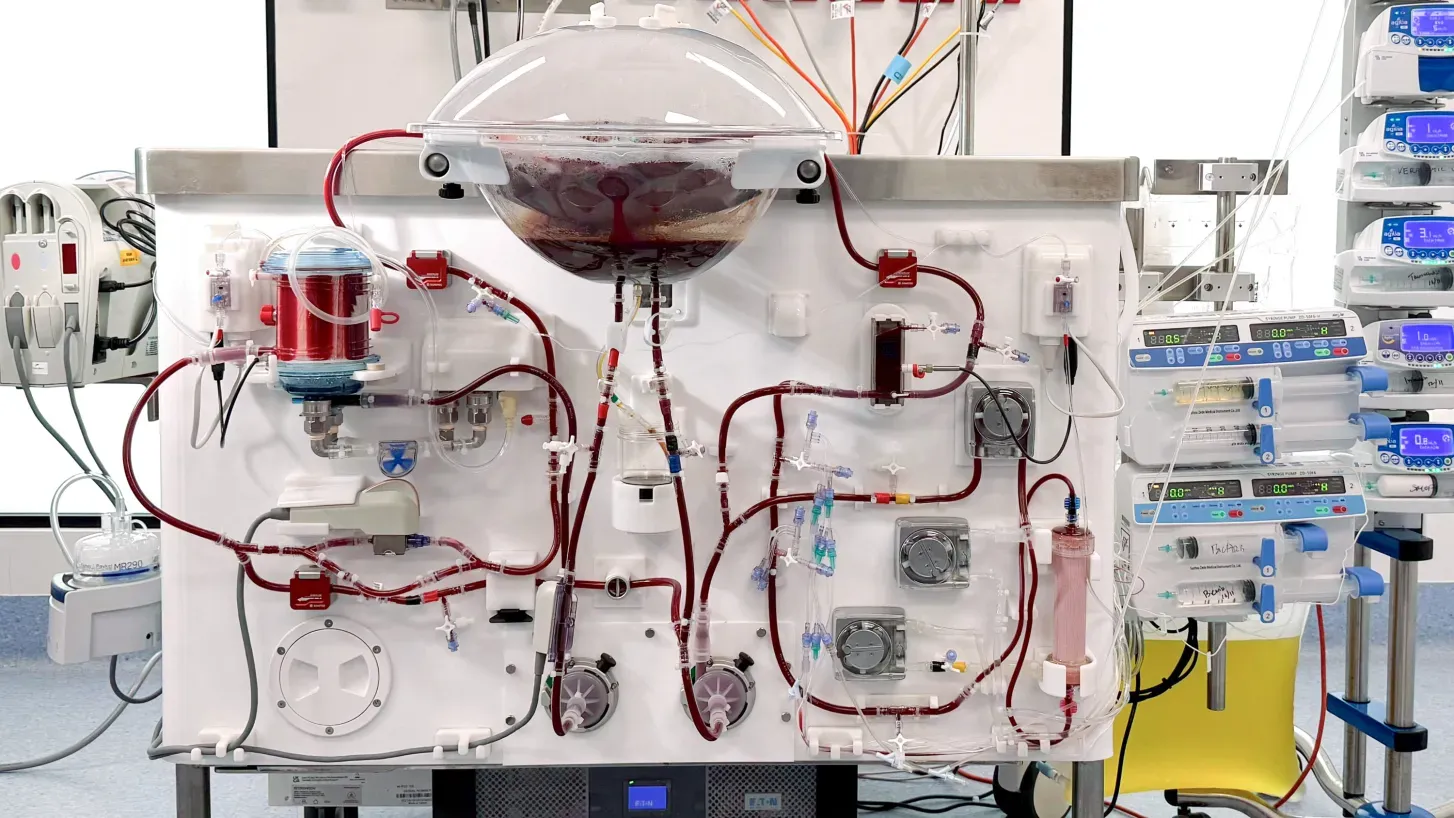
Researchers in Australia claim they’ve kept a human liver alive, on life support, outside the body for seven weeks, opening up speculative new possibilities in biomedical engineering.
The feat, whose details are pending publication, was carried out in Sydney after a team led by surgeon and inventor Carlo Pulitano connected a donated liver to a system of automated pumps and sensors that fed the organ nutrients, supplied it with blood, and whisked away waste.
In an interview, Pulitano, a transplant surgeon at the Royal Prince Alfred Hospital and a professor at the University of Sydney, likened the life support system to “an artificial body.” Its official name is the Extended Organ Perfusion System. (via MIT Technology Review)

- Models can now transmit viruses in weight-space
- Pancreatic cancer halted by virus injection in three patients
- High-resolution bionic eye combines color imaging with more efficient motion detection
- Team maximizes efficiency of heavy rare-earth elements for high-performance permanent magnets
- A single sensor offers ultraprecise reconstruction of light information
- Flip side: Upside-down atomic layers could steer heat in stacked computer chips
- Single-propeller drone uses its own spin to scan surroundings in all directions
- This tiny magnet could turn ordinary transistor circuits into artificial neurons
- Are T cell 'engagers' the next big thing in autoimmune disease treatment?
- A little manganese makes a big difference for next-generation batteries
- Brain researchers afflict LLMs with 'injuries' similar to those of stroke victims to unpack AI language mechanisms
- New MEMS atomic cell platform accelerates design optimization for chip-scale atomic clocks
- Multilayer printed circuit boards made from paper
- Light-activated nanoparticles may help treat head and neck cancer

- Isomorphic Labs raises $5B for AI-driven drug discovery platform and clinical molecules
- Plural raises €1B for operator-led VC backing European deep tech moonshots
- Sofinnova closes €725M crossover fund for late-stage European biotech companies
- Genesis AI raises $500M Series A for sensor-gloved humanoid robots with dexterous manipulation
- Science Corporation raises $400M Series D for implantable chips restoring vision and brain-computer interfaces
- Hone Health raises $228M for a physician-led longevity platform with AI-driven personalized treatments
- MegaRobo Technologies raises ~$200M for AI-powered robotic laboratory automation for drug discovery
- Marrow Therapeutics raises $173M Series A and B for bone marrow-targeted genetic medicines for blood disorders
- Stark Future raises over €150M for electric motorcycles designed to outperform combustion bikes
- Galvanize Therapeutics raises $130M Series D for pulsed electric field ablation in oncology and chronic disease
- General Flash raises $128M Seed and Series A for emissions-free critical metals refining via solid-state flash electrolysis
- Corma raises $125M Series A for AI foundation models powering autonomous defensive cybersecurity
- Ramon.Space raises $124M Series B for radiation-hardened onboard space computing infrastructure
- Seawolf Therapeutics raises $100M for specialized lipid nanoparticles to deliver DNA therapeutics
- Flagship Pioneering raises £100M for AI-driven biotech company creation in the UK
- Noeri raises $110M for a self-improving AI platform for enterprises and scientific discovery
- Boltz raises $110M Series A for biomolecular AI foundation models accelerating drug discovery
- BrightAI raises $97M for a Physical AI platform monitoring power, water, and heavy industry assets
- VitriVax raises $87M Series C for thermostable single-dose vaccine platform
- Ansa Biotechnologies raises $71.5M Series C for enzymatic DNA synthesis delivering clonal DNA up to 50 kilobases
- Pulley raises $64M Series B for an AI-native permitting and construction development platform
- Remedy Robotics raises $62M Series B for AI-enabled robotic systems for neurovascular and cardiovascular intervention
- Commit Biologics raises $60M seed for complement-powered immune engagers targeting autoimmune disease and oncology
- LanceDB raises $57.5M Series B for multimodal data curation, search, and feature engineering at scale
- Humyn Labs raises $47M Series A for real-world human activity data for robotics AI training
- Compute Desk raises $45M seed for GPU pricing, trading, and clearing infrastructure
- Knit Health raises $35M Series A for an AI world model forecasting patient care needs and intervention outcomes
- Orakl Oncology raises $34M Series A for AI and tumor organoid cancer treatment prediction platform
- Remanence raises $30M seed for a continual learning platform that lets enterprises build and own AI models
- Promise Robotics raises C$40M Series B for a Physical AI platform that turns home designs into robotic production plans
- Dcubed raises €27.2M Series A+ for satellite actuators and deployable solar arrays
- Onward Therapeutics raises US$28M Series B for bispecific antibody and cell therapy targeting cancer drug resistance
- Bharat Semi raises $24M seed for programmable AI-enabled image sensors on a single chip
- Bedrock Energy raises $24M for AI-directed geothermal drilling rigs for commercial buildings
- Intergrid raises €23.5M for autonomous industrial energy management platform
- Drogue raises $20M for ocean-thermal floating AI data centers cooled by seawater
- Traitomic raises €20M Series A for non-GM trait discovery in plants and microorganisms
- Speakeasy raises $18.8M Series A for operating infrastructure platform for venues and live experiences
- Gama raises $16.7M seed for solar arrays and power-management systems for satellites
- Valkryn raises $15M seed for independent evaluation infrastructure for autonomous warfare systems
- Darcy Geothermal raises $15M Series B for groundwater-enabled geothermal heating and cooling
- Optain Health raises $13M for AI-powered robotic retinal imaging in primary care
- Nodal Networks raises $11.3M seed for AI decision intelligence platform for container terminals
- Iconic raises $10M Seed for AI that catches contradictions in energy and infrastructure megaproject documents
- TerraCycle US raises $10M Regulation A for recycling hard-to-recycle materials across 400+ waste streams
- TestDynamics raises $9M Series A for vendor-neutral algorithm benchmarking infrastructure for radiologists
- Aarden raises $8M for an AI-native land intelligence platform for energy and AI infrastructure
- Mosaico raises €7.5M seed for an open-source sensor data orchestration platform for robotics and physical AI
- MountAIn raises €7.3M seed for deploying AI on ultra-low-power embedded microcontrollers
- Modern Industrials raises $6M seed for AI agents embedded in manufacturers' and distributors' workflows
- Tesorai raises $5.3M seed for a searchable AI knowledge layer for life sciences proteomics data
- Qluster raises €4.7M pre-seed for continuous-variable photonic quantum computers using entangled light at room temperature
- Asynchronics raises $3.1M seed for affordable spacecraft digital-twin simulation software
- Opdo raises $2.3M pre-seed for AI-native optical engineering design-to-manufacturing automation

Grazing sheep in fields with solar arrays / Giant Roadside Attractions Face Mounting Costs and an Uncertain Future / A.I. Just Blew Up a Key Tenet of Computer Science / US tightens AI chip export controls to deter Chinese companies from accessing compute remotely / AI models can be tricked into identifying civilians as military targets by telling them it's a game / Elon Musk says SpaceX has a plan to eliminate cell phone dead zones / China is importing thousands of research primates, sparking fears of monkey trade war / I got to eavesdrop on AI agents doing science. It was eye opening / Regular Tech Bros Are Worried About Honeypots / No Pilots. Few Air Traffic Controllers. What Could Go Wrong? / "It runs Doom" is more than a meme. The reason lies in its engineering / The open-source movement wants Jensen Huang back / AI Told These Ex-Google Guys How to Build a Billion-Dollar Weapons Business / Why Nvidia is betting on silicon photonics to scale AI / 'Just Ridiculous': A Famed Philosopher Takes on AI Consciousness / A Muslim Author Is Suing xAI After People Used Grok to Strip Her Hijab / LLMs are developing filthy mouths / Google Built a Giant 'Mirror Dimension' Internet to Test Its Chrome AI Agents / This 16-Year-Old Founded an AI Missile Startup. He's Targeting 'Cost per Kill' / Hair goes electronic for monitoring brain signals / Major AI platforms generated viable plans for terrorist attacks, GAO finds / A $1.1 trillion Pentagon budget plan sets up a fight on Capitol Hill